Paid ads are mostly closed to NJ dispensaries, promotion rules are tight, and one SMS mistake can cost $500 to $1,500 per message in TCPA claims. The stores winning repeat business in 2026 aren’t the ones with the biggest ad budgets. They’re the ones with the best retention system.
Five channels do the work: compliant SMS, local SEO, first-party data, NJ-compliant loyalty, and owned media. Build all five and customers come back without you paying Meta or Google a cent.
Jump to the channel you need
What NJ Lets Dispensaries Do
This is how compliance counsel and the NJ Cannabis Regulatory Commission (CRC) tend to read each channel today. Confirm specifics with your compliance officer before you launch anything.
| Channel | Allowed With Guardrails | High Risk |
|---|---|---|
| Paid social (Meta, Google, TikTok) | Organic profiles only. Paid cannabis ads are mostly auto-rejected. | Running paid cannabis ad copy on any of the three |
| SMS | Yes, with written consent and 8 a.m. to 9 p.m. send times | Texting numbers that never opted in, scraped lists, bought lists |
| Google Business Profile | Yes, within platform policy | Health-claim photos, menu items not in stock, fake scarcity |
| Organic social | Yes | Health claims, imagery that appeals to minors, photos from restricted zones |
| Local SEO and blog content | Yes | Copy-paste city pages across dozens of NJ towns with nothing unique |
| Loyalty rewards | Yes, when points become a discount on a future purchase | Points for free product, auto-stacked discounts, sweepstakes-style rewards |
| Yes, CAN-SPAM compliant with tagged consent | Bought lists, false headers, hidden sender | |
| Billboards and signage | Yes, outside distance limits near schools and youth sites | Signs inside restricted zones or visible from school grounds |
Channel 1 of 5
SMS Built for TCPA Compliance
Red flag: you send marketing texts to numbers with no consent record on file.
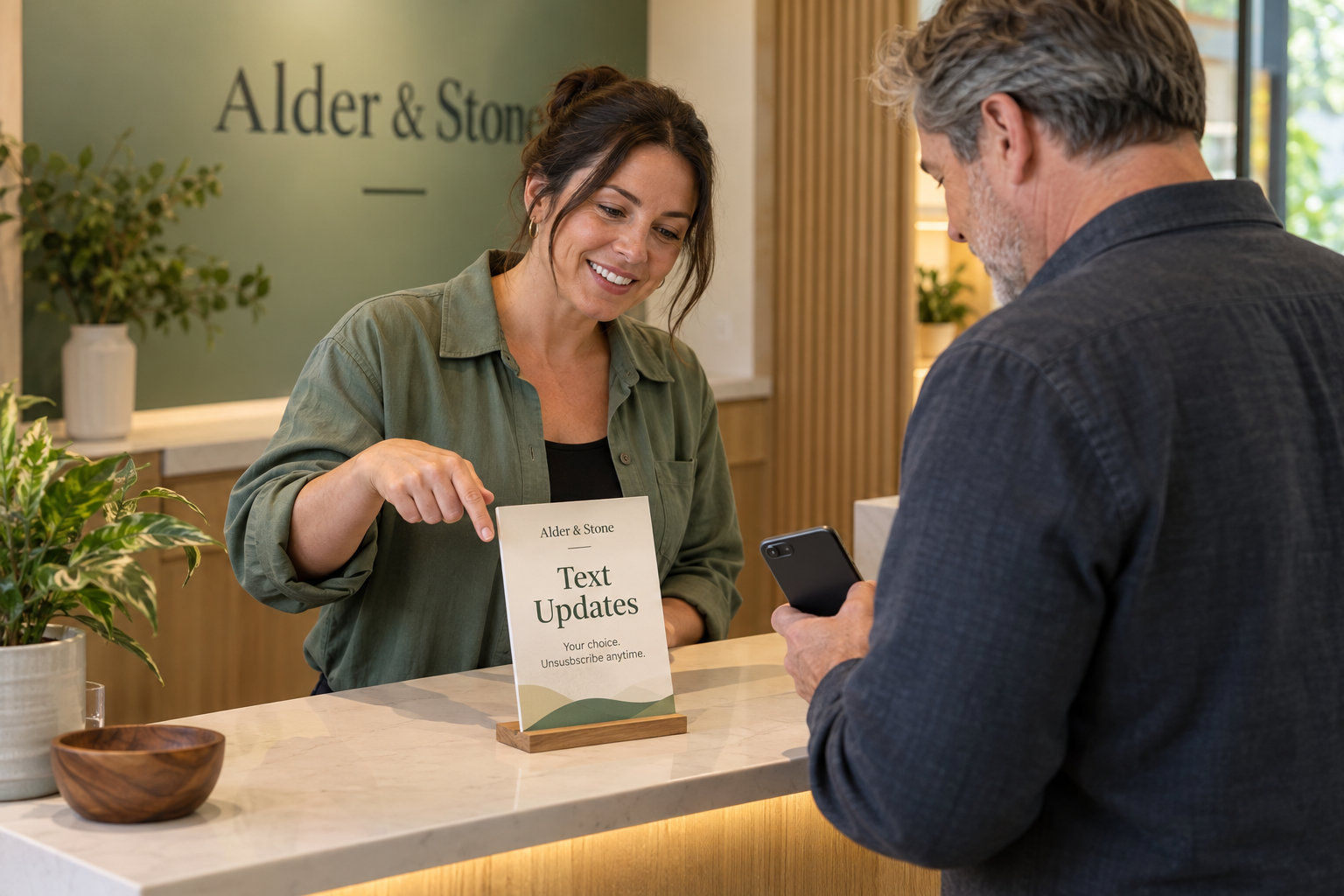
SMS is a dispensary’s highest-return channel and its most expensive mistake. The risk isn’t the messaging bill. It’s the per-message TCPA exposure.
A compliant program has six parts:
- Written consent at the moment you collect the number
- A stored consent record with timestamp, IP address, and the exact opt-in wording
- A sender name the customer knows (your store name)
- STOP, HELP, and UNSUBSCRIBE on every message
- Message frequency and purpose stated at sign-up
- Sends only between 8 a.m. and 9 p.m. local time
Miss any one of these and you have the version of the program that ends up in a demand letter.
Quick Diagnostic
- Do we have a consent record (timestamp, IP, opt-in wording) for every number on our list?
- Does our sender name match the brand the customer signed up for?
- Are STOP, HELP, and UNSUBSCRIBE on every message, including order updates?
- Do all sends land between 8 a.m. and 9 p.m. NJ time?
- Have we removed numbers that were bought, scraped, or pulled from a giveaway?
Why it compounds: TCPA class actions spread from one complaint to a whole store group. Protect the consent records, not only the wording of the message.
See also: Channel 4, Loyalty. Loyalty updates go out by text, so both compliance risks live in the same message.
Channel 2 of 5
Local SEO and Google Business Profile
Red flag: your profile is verified, but the menu is 30+ days old and this week’s reviews have no reply.
Most new customers find you by searching “dispensary near me” or “weed in [city].” The store that wins that click has the strongest Google Business Profile (GBP), the cleanest categories, recent photos, and steady local signals.
Google lets dispensaries verify and run a profile. It limits what you can advertise, not the profile itself. So the work is organic:
- Post weekly
- Reply to every review, including 1-star reviews
- Keep your menu synced
- Keep your name, address, and phone (NAP) identical on every listing
This work builds quietly for 60 to 90 days, then shows up as a steady weekly lift. Start late and you miss it.
Quick Diagnostic
- Was our GBP updated in the last 7 days?
- Do we reply to every review within 24 hours?
- Does the menu (or a verified part of it) update on the profile weekly?
- Is our NAP identical on Weedmaps, Leafly, Dutchie, Yelp, and cannabis directories?
- Do we have 25+ owner photos from the last 60 days?
Why it compounds: reviews feed the local map results, map results drive “near me” clicks, and those visits feed your email and SMS lists. Stop the work and the map results fade the same quarter your cost per customer climbs.
See also: Channel 3, First-Party Data. Your reviewers are your highest-intent audience, and they cost nothing.
Channel 3 of 5
First-Party Data Capture
Red flag: your lists are growing, but no one can say where a given contact signed up.
The channel that survives every platform ban is the one you own: the email, the phone number, and the consent record. Paid social is mostly closed. Display ads are gated. Paid search is restricted.
Capture data at every touchpoint:
- An opt-in offer on every receipt
- Separate, unchecked SMS and email boxes at online order pickup
- One budtender ask, after the third visit
- Sign-in sheets at every in-store event
- A CRM tag for where each contact came from
You don’t need expensive software. You need a clean path from sign-up to follow-up. That path breaks easily: source tags vanish when vendors change, opt-in wording changes, and last quarter’s export isn’t the record a regulator will ask for. Audit it every quarter, not after something breaks.
Quick Diagnostic
- Can we name the sign-up source for every contact on every list?
- Does online pickup ask for SMS and email on separate, unchecked boxes?
- Do budtenders ask once, on the third visit, not the first?
- Do we have 3+ capture points beyond the receipt?
- Is the CRM split by source (receipt, online order, event, sign-up)?
Why it compounds: first-party data survives algorithm changes and CRC crackdowns. It also powers every other channel on this list.
See also: Channel 1, SMS. Audit both lists together or you’ll do the work twice in a TCPA review.

Channel 4 of 5
Loyalty Built Within NJ Promotion Rules
Red flag: your loyalty copy says “earn 50 points, get a free pre-roll.”
The line between compliant loyalty and a non-compliant promotion is sharper than most owners think. Compare:
High risk: “Earn 50 points, get a free pre-roll.”
Compliant: “Earn 50 points, redeem for $5 off your next purchase.”
The customer barely notices the difference. The regulator does. A workable NJ program has five rules:
- Points are based on purchase amount, not a specific product
- Points redeem only as a discount on a future purchase, never for free product
- Points can’t be transferred
- Points don’t stack with first-time or veteran discounts by default
- Copy makes no health or therapeutic claims
Most programs fail at copy review, not the rules. Check every text, email, and receipt footer that mentions loyalty against the same checklist before it goes out.
Quick Diagnostic
- Can points ever turn into free cannabis product?
- Are points redeemable only as a discount on another purchase?
- Is all program copy free of health or therapeutic language?
- Are points tied to one verified account and non-transferable?
- Are redemption rules written and visible at sign-up?
- Does the program stack with other discounts by default? If so, why?
Why it compounds: if the CRC classifies your program as a non-compliant promotion, you get a finding. The finding brings a fix-it plan. The plan pulls staff hours off the floor, and a small marketing problem becomes a labor problem.
See also: Channel 5, Owned Media. Without a place to announce your program, SMS carries both risks alone.
Channel 5 of 5
Owned Media Like Email, Content, and Events
Red flag: if Meta changes its policy tomorrow, your brand has nowhere left to talk to customers.
Your Instagram account is rented. Owned media is the only space you control. Build four pieces:
- A weekly, CAN-SPAM compliant newsletter people open
- A blog or menu guide people bookmark
- A monthly in-store event that drives social posts and repeat visits
- A creator program run under NJ rules (disclosed payments, no imagery that appeals to minors, no health claims)
Expect 60 to 180 days before list growth pays off. The same rented-space risk now applies to cannabis directories, listing services, and ad platforms whose policies change every quarter.
Quick Diagnostic
- Do we email opted-in subscribers at least once a month?
- Does our brand voice still work without paid social?
- Do we host at least one in-store event per month?
- Does our creator program follow NJ rules?
- Do we publish original content (menus, education, recaps) at least monthly?
Why it compounds: customers you own come back no matter what Meta decides next week, and each send costs almost nothing.
See also: Channel 2, Local SEO. Your blog content also earns rankings, so run both on one calendar.
Three or More Red Flags Means a Channel Problem
If three or more channels above raised a red flag, your issue isn’t paid vs. organic. It’s that you’re relying on channels you can’t use. Most cannabis marketing plans assume Meta and Google carry half the load. They can’t.
The stores growing now built first-party data and compliant loyalty while competitors waited on ad approvals. Build your audit trail now and compliance becomes an edge, not a tax.
Find Your Compliance Gaps Before the CRC Does
SMBCC checks your store the way the state would, then helps you fix what we find. We write the SOPs and train the staff behind your sign-ups, loyalty program, and daily operations.
Frequently Asked Questions
Is SMS marketing legal for NJ cannabis dispensaries?
Yes, if every recipient gave documented written consent. Use a sender name the customer knows, include STOP, HELP, and UNSUBSCRIBE on every message, state frequency at opt-in, and send only between 8 a.m. and 9 p.m. local time. The risk isn’t SMS itself. It’s sending without a consent record you can produce for each recipient.
What is the biggest TCPA risk for dispensaries running SMS?
A missing or weak consent record. Marketing texts need prior express written consent, and you must be able to retrieve it: timestamp, IP or device ID, the opt-in wording, and the capture source. Lists from giveaways, data vendors, or old POS exports without that trail are the exposure.
Can NJ dispensaries run paid Google or Meta ads?
Not in any useful way. Meta blocks most cannabis ads, Google rejects dispensary ad copy, and TikTok is stricter than both. NJ law doesn’t ban cannabis marketing, but the platforms set the limit. Plan around GBP, organic social, owned media, and cannabis-specific placements like Weedmaps and Leafly.
What loyalty rewards does NJ allow vs. flag?
Typically allowed: points earned on purchase amount, redeemable only as a discount on a future purchase, non-transferable, not stacked by default, and free of health claims.
Typically flagged: points for free product (pre-rolls, edibles, eighths), auto-stacked discounts, and rewards for quizzes or reviews that look like sweepstakes. Verify specifics with your compliance counsel.
How often can a dispensary send marketing texts?
There’s no federal weekly limit, but send times are limited to 8 a.m. to 9 p.m. local time. The real rule is predictability. A customer who signed up for a Friday noon text knows what to expect. A customer who gets six texts a day may become the complaint that starts a lawsuit.
What customer data should a dispensary collect at checkout?
Email and phone, each with its own unchecked opt-in box and consent wording. Tag every contact with its source (receipt, online pickup, event). The source tag is what makes a list defensible later. Have budtenders ask once, after the third visit, and never make it feel required for service.
SMB Cannabis Consultants (SMBCC) provides consulting services only and does not provide legal advice. Confirm all marketing decisions with your compliance counsel.
